


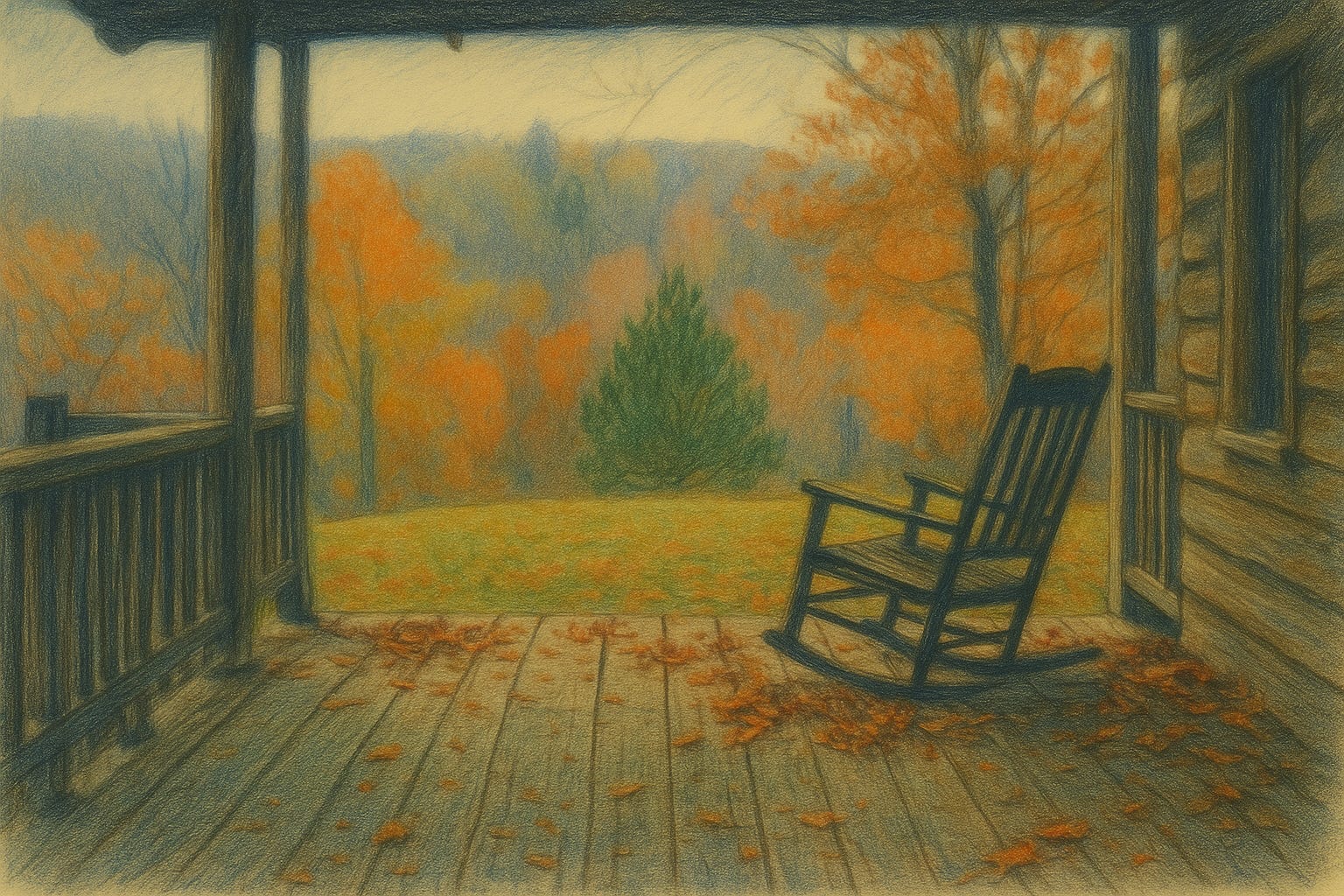
On most mornings, I roll out of bed, wipe the sleep from my eyes, pull on a pair of sweatpants and throw on a long tee, meander into the kitchen, grind two tablespoons of dark espresso beans, pour my latte, and wander to the porch to sit. There, I sip from a stone mug and glimpse more of my foggy breath in the cold this time of year. The porch offers me a view of the woods. Leaves lightly rustle on branches in the wind, fall to the ground here and there. Squirrels gather acorns. A female cardinal chirps, flies, and lands near its partner. My mind drifts to another place, and when I notice it has, I return my attention to the ordinary glory around me. I sip some more, then again, and abide there until I’ve both finished my coffee and remembered I come from nature and can always return to it. It is an illusion that we are ever disconnected.
This is the most precious part of my day, and it is a time hidden from anyone else. I take no phone or book or stimulation to the porch (except for my coffee). Porch sits ground and activate my senses in a slow, mostly effortless manner. I need only bring my body.
Today, we live in an age where the loudest, most impatient voices dominate our senses. We are bombarded with how-to content, bad news, and distracting reels. Many of us feel a pervasive need to be plugged in, switched ‘on’—perhaps under the premise staying digitally connected means we are “in touch” and, from there, can make a difference.
Yet when I am unplugged, I feel most connected. It is the unhurried acts that gently cleanse.
I like to remind myself that I can be alone with me. To do nothing, and that nothing is quite something. My morning stillness is not without any effort: the most fruitful occasions are whenever I sit there for longer than I want. That is a discipline in itself. To unplug, to wait, until I find myself lost in now.
This quiet ritual has revealed to me that many of the important experiences I have will remain largely unknown. There will be no fanfare or accolades. Alone, I witness myself during a porch sit. Much of our lives is unseen by others—what we think and say and do often remains obscure.
Are you content to witness yourself?
In a world trained to react, choosing to be still can feel radical. Yet the shape of the world reflects the shape of our collective attention.
Giving our attention to reality TV and constant distraction on social media, for instance, may have facilitated the rise of a former-reality-TV-star-turned president, a person who is loud, inflammatory, and demands attention. For him and other leaders like him, I would argue their rule requires our giving them attention, lest they lose their foothold.
And so, as certain leaders rage and divide and we continue to bend our ears, we give them what they want.
The author Italo Calvino once reflected it is not the mouth that shapes the story, but the ear1. Tyrants in the digital age benefit from our attention: from our incessant scrolling on apps and purchases from companies backed by their allies, to our consumption of incendiary remarks on news feeds that feed on fear. Being loud sells. And with our ears, they shape the story of humanity.
Could sitting on our porches doing nothing spark a rebellion? We know there are different forms of protest, many of which are useful. In a digital age, one less tried may be to boycott who and what we give our attention to. To unplug, which is not the same as sticking our heads in the sand, may be one of the most radical forms of protest available to us today.
Unplug. Unwind. Undermine.
Perhaps more than ever, we are in need of finding and giving our attention to still, small voices amid the cacophony. It may be difficult for our ears to distinguish them at first, as we may be accustomed to engaging with those who lead by banging about. But still, small voices have not become too small. They are there. Rustling leaves. Chirping birds. Running streams. Ordinary people doing hard, human work. And… the still, small voice humming through every fiber of your human being is there, too, where it has always been.
When we scroll, we chase what’s trending. But when we are still, we begin to notice what endures. You can always choose to tune your frequency to the soul of the universe. By lending your ear and, at other times, withholding it, you can reshape the story humanity unfolds.
What will you listen to today?
In the waiting, we become who we are. More prepared for what might want to be reeled in.
Out here, we’re fishing the universe together.
thoughtworms are hooks for aliveness, short casts into deep waters.
innersparks are essays that keep the light, long fires for a long night.
offlines are composed without internet from memory and attention, honest on purpose.
Here, we return to Ourselves, again and again. Reminded we are stardust burning in the darkness. The darkness cannot overcome us.
Samir and I built Your Epic Ordinary Life for people ready to say aloud what they’ve been carrying—a guided memoir experience with someone sitting across from you who knows how to listen longer than is comfortable. Start with our guide, “5 Principles of Telling Your Life Story.” It’s free, but won’t feel like it.
All of my work is in service of ushering in a New Renaissance. Historically, renaissances have preceded social renewal and needed revolution. They are the inner work before the storm, the slow clearing that helps us see what we’re building toward and what we’re willing to march for. If you’d like to support this work, consider joining my Patronage Circle.
To get every entry I write, you can upgrade to a paid subscription.
Or become a founding subscriber and receive a complimentary ‘deep cast’ session. If you feel something in your life pulling on the line and don’t have words for it yet, we can sit together on Zoom, pour something worth drinking, and fish.
Paraphrased from the twentieth century Italian novelist and short story writer Italo Calvino. “It is not the voice that commands the story: it is the ear” is the precise line used in Invisible Cities.